


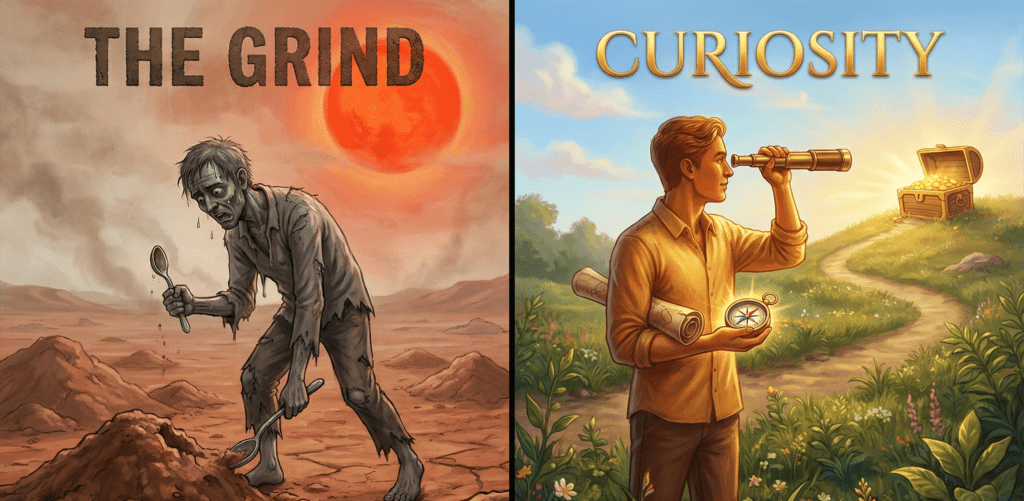
TL;DR – The Hustle vs. Curiosity Cheat Sheet
- The Trap: “Grind Culture” treats raw effort as the prize, leading to burnout and linear growth.
- The Shift: Curiosity treats insight as the prize, leading to leverage and exponential growth.
- The Science: Persistent hustle depletes the prefrontal cortex; curiosity replenishes it with dopamine.
- The Fix: Stop trying to “dig faster” (Hustle). Start asking if you’re digging in the right spot (Curiosity).
For decades, the professional world has debated Hustle vs. Curiosity, often selling us a lie: The secret to success is “The Grind.” Wake up earlier. Work longer. Out-hustle everyone.
But in a complex world, sheer effort isn’t a competitive advantage—it’s often a cognitive liability. Research from the Harvard Business Review confirms that when curiosity is encouraged over blind execution, decision-making improves and innovation spikes.
The modern path to success isn’t about working harder. It’s about shifting your operating system. In the battle of Hustle vs. Curiosity, the latter wins every time because it focuses on leverage rather than brute force.
Here is the difference between the two mindsets.
The Cheat Sheet: Hustle vs. Curiosity
| Feature | Grind Culture (The Trap) | Curiosity-Driven (The Cheat Code) |
|---|---|---|
| Primary Fuel | Willpower & Discipline | Dopamine & Interest |
| The Feeling | “I have to do this.” | “I want to know this.” |
| Approach | Brute Force (Pushing) | Problem Solving (Pulling) |
| Core Belief | “Hustle creates luck.” | “Strategy creates opportunity.” |
| Outcome | Burnout & Linear Growth | Mastery & Exponential Growth |
1. Hustle vs. Curiosity: The Hidden Costs
We often view hustle as a badge of honor, but biologically, it is expensive.
1. It Makes You Dumber
Persistent “grind mode” necessitates a high cognitive load that eventually leads to job burnout. This state exhausts your prefrontal cortex, making you physiologically incapable of the divergent thinking required for innovation. While “grinding” might make you feel productive in the moment, it depletes the cognitive resources your Future Self needs to solve complex problems.
2. The “Yerkes-Dodson” Trap
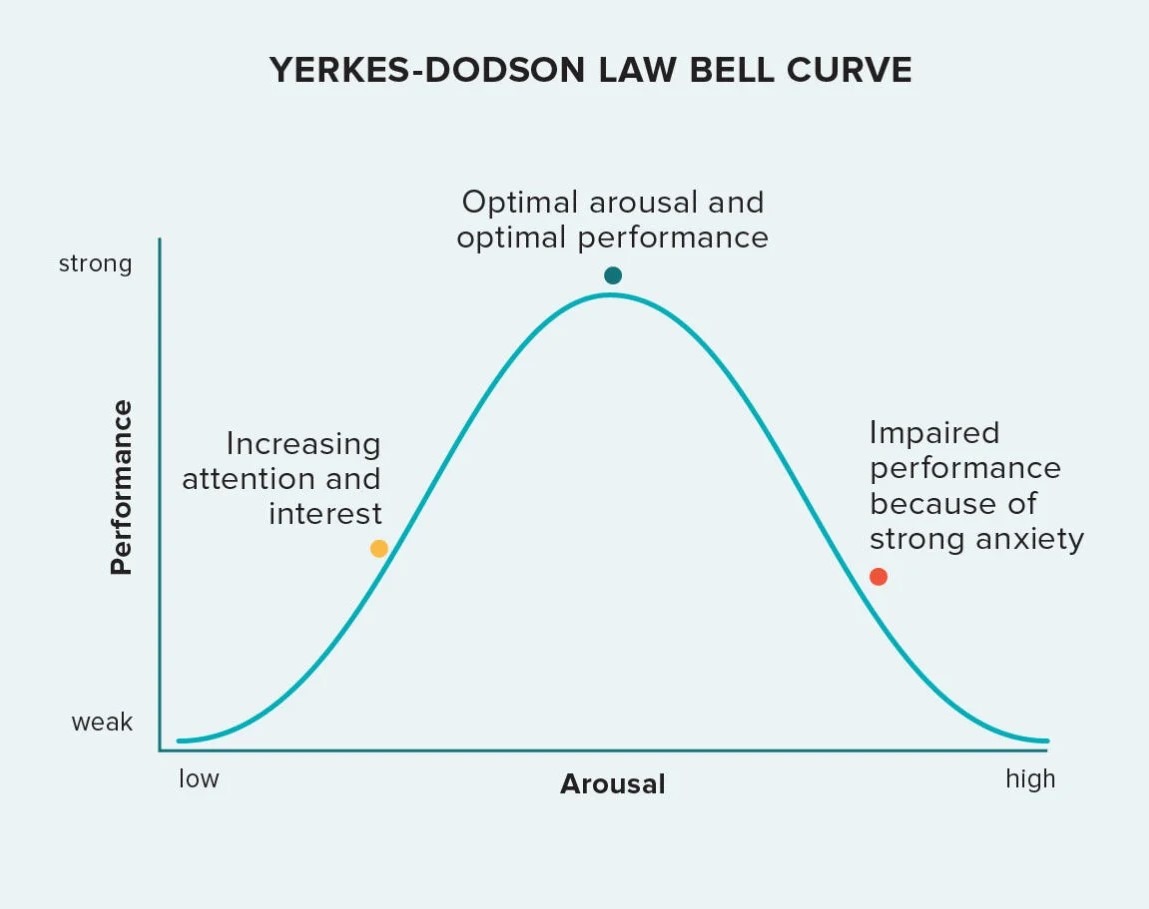
According to the Yerkes-Dodson Law, performance increases with stress only up to a point. Beyond that, “working harder” actually degrades your output.

3. The “Hustle-Luck” Myth
We inherited the belief that “the harder we hustle, the luckier we get.” Often, however, we are just generating friction, not progress. You can dig a hole with a spoon very quickly (high effort), but it’s still the wrong tool. Hustle rewards digging; Curiosity rewards asking for a shovel.
2. Your New Job: The Chief “Space-Clearing” Officer
You cannot think strategically when your calendar is full of reactive execution. To shift from Hustle to Curiosity, you must dismantle grind culture by deliberately “clearing space.”
The 4-Step Space-Clearing Audit:
- The Activity Audit: List every recurring task. Which ones are just “grind theater” performed to look busy?
- Cognitive Load Reduction: Ruthlessly eliminate or automate low-value tasks to free up mental bandwidth.
- Legitimize “Why”: Explicitly tell your team (or yourself) that asking “Why are we doing this?” is more valuable than just doing it fast.
- The “Assumption Audit”: Schedule specific times to question the very foundations of your current projects.
The Cheat Code: If you are too busy to ask “Why,” you are too busy to succeed.
3. Stop Rewarding Effort. Start Rewarding Insight.
The biggest trap of the Hustle vs. Curiosity dynamic is that traditional management measures the wrong things. If you measure hours, you get busywork. If you measure insight, you get efficiency.
This obsession with rigid output turns your career into a “fragile contract.” As discussed in our comparison of Goals vs. Dreams, relying on sheer force without a strategic anchor is a recipe for failure.
Shift your personal KPIs:
- Stop Measuring: Hours logged, overtime, and volume of tasks.
- Start Measuring: Obsolete assumptions challenged, efficiency gained by eliminating tasks, and the quality of strategic pivots.
The Verdict
Modern success requires the courage to value questions over the seductive myth of the hustle.
Stop trying to win a race of endurance. Start a journey of exploration. The goal isn’t to be the most tired person in the room; it’s to be the one who knows where the room is going.
Frequently Asked Questions
What is the main difference in Hustle vs. Curiosity?
The main difference is the fuel source. Hustle relies on finite willpower and stress (pushing), while Curiosity generates its own energy through dopamine and interest (pulling).
Why is hustle culture toxic?
Hustle culture becomes toxic when it prioritizes “activity” over “outcome.” It encourages burnout by rewarding the appearance of hard work (long hours) rather than the actual value created (strategic breakthroughs).
What is the Curiosity Quotient?
The Curiosity Quotient (CQ) measures an individual’s ability to tolerate ambiguity and ask questions. In modern leadership, a high CQ is often more predictive of success than IQ because it drives adaptation and learning.