


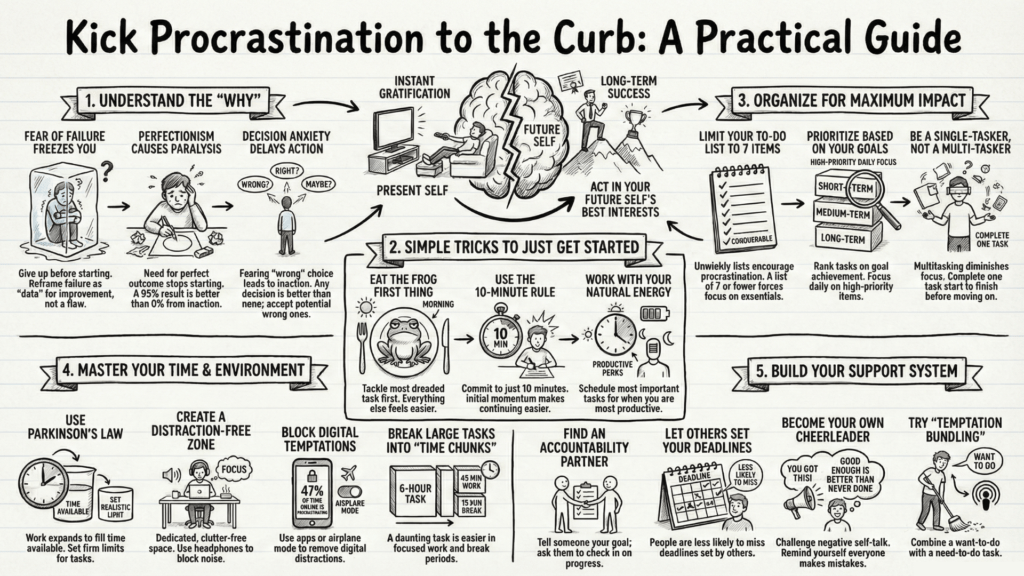
Are you struggling to overcome procrastination because you consistently underestimate how long a task will take? Do you find yourself reorganizing your desk when you should be finishing a report? If this sounds familiar, you aren’t lazy. You are simply stuck in a battle between your “present self” and your “future self.”
Your present self craves instant gratification—one more episode, one more scroll—while your future self wants the satisfaction of success. This internal conflict is a classic example of Present Bias, our natural tendency to prioritize immediate rewards over future ones.
The key to winning this battle isn’t about having “more discipline”; it’s about understanding the psychology behind why you delay. Here are six counter-intuitive strategies to get your present self to work in your future self’s best interest.
1. The “Rule of 7”: Why Your To-Do List is Sabotaging You
One of the most counter-intuitive truths about productivity is that an overly long to-do list is a direct driver of procrastination. When a list stretches on endlessly, it triggers “decision paralysis,” making it easier to avoid the list entirely.
2. Reframe Failure as “Data,” Not Defeat
A primary driver of procrastination is perfectionism. We put off tasks because if we don’t try, we can’t fail. This paralysis stems from viewing failure as a verdict on your character.
Stop viewing a bad draft or a missed target as a reflection of your worth. Instead, view it simply as data. A test result of 95% isn’t perfect, but it is infinitely better than the zero you get from not trying.
3. Outsource Your Accountability
We rarely respect the deadlines we set for ourselves. It’s easy to break a promise you’ve only made to yourself—after all, who is going to know?
The data backs this up. A 2002 MIT study found that students given externally imposed deadlines performed significantly better than those allowed to set their own schedules [1].
4. Beat the “Planning Fallacy” by Mastering the Start
We often dread tasks because we imagine them to be more painful and time-consuming than they actually are. This is known as the Planning Fallacy. The trick to beating it isn’t heroic effort, but “micro-starting.”
3 Techniques to Start:
- Eat the Frog: As Mark Twain famously said, “If it’s your job to eat a frog, it’s best to do that first thing in the morning.” Tackle your most dreaded task first.
- The Ten-Minute Rule: Commit to doing the dreaded task for only ten minutes. Often, the friction is only in the start.
- Energy-Based Scheduling: Stop fighting your biology. Aligning tasks with your natural energy rhythms reduces the friction that leads to procrastination.
5. The “Do Less” Paradox
It sounds backward, but you can often achieve more by doing less. We naturally procrastinate on work that feels tedious or low-value. The most effective way to handle these tasks is to remove them using the EDG Framework:
1. Eliminate: If it has no consequence, delete it.
2. Delegate: If it’s necessary but you hate it, outsource it.
3. Gamify: If you must do it, race the clock to trigger dopamine.
6. Silence the Inner Critic
You cannot overcome procrastination if you are drowning in negative self-talk. When you delay, you feel guilty, which lowers your confidence and makes you more likely to procrastinate on the next task. It is a vicious cycle.
To break it, you must manage your internal monologue. Catch yourself saying “I’m so lazy” and reframe it to “I struggled with scheduling today, but I can adjust for tomorrow.”

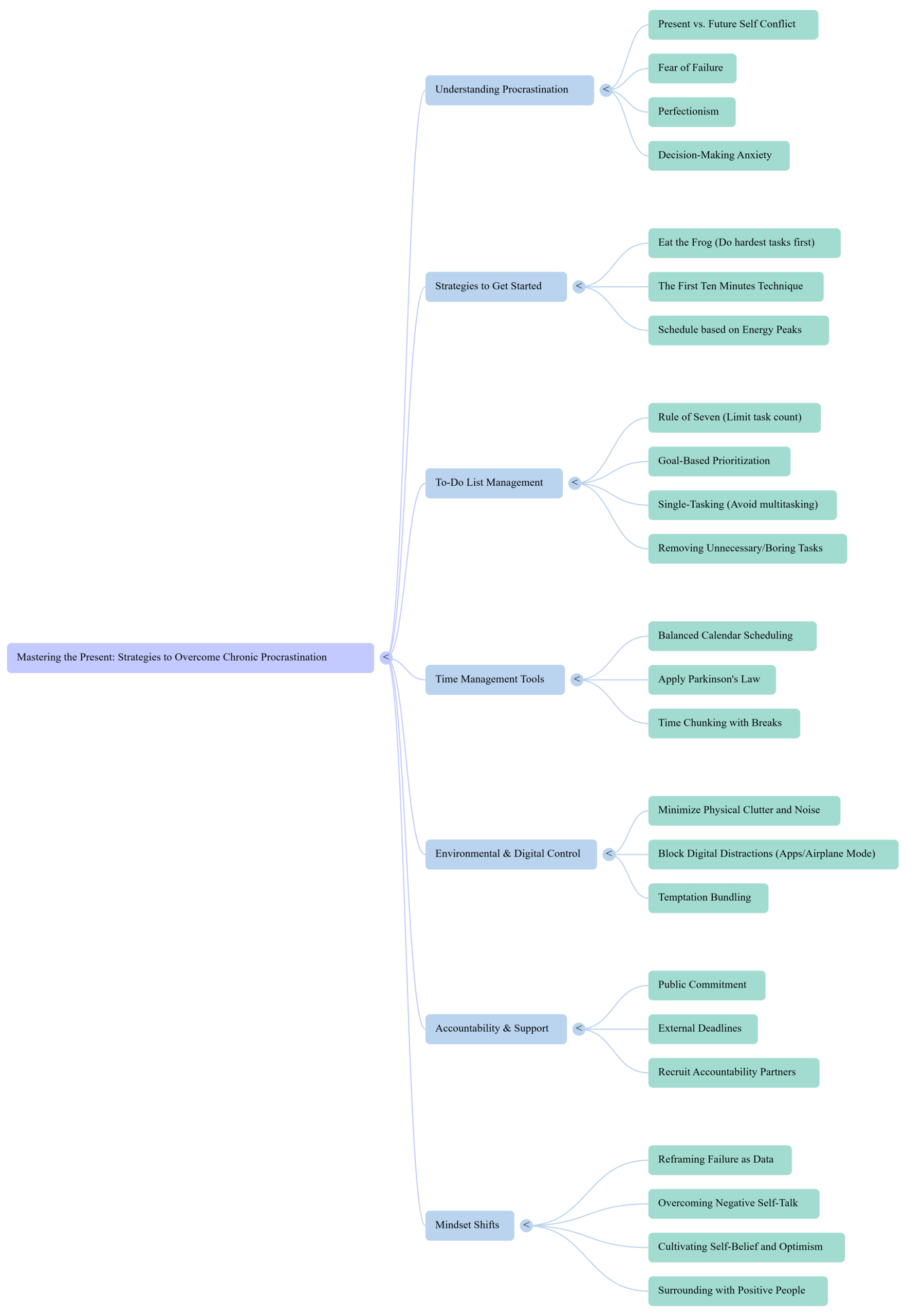
Bonus: 3 Advanced Environmental Tactics to Overcome Procrastination
Your featured roadmap (Fig 1) mentions a few advanced strategies for those ready to level up. Here is how to apply them:
1. Apply “Parkinson’s Law”
The old adage states: “Work expands to fill the time available for its completion.” The fix is to set artificially aggressive deadlines. Give yourself 90 minutes for a task that usually takes three hours.
2. Try “Temptation Bundling”
This concept, coined by behavioral researcher Katherine Milkman, involves coupling something you want to do with something you need to do. Only allow yourself to listen to your favorite podcast while you are cleaning the garage.
3. Create a Distraction-Free Zone
Willpower is a finite resource. Design your environment for focus by putting your phone in “Airplane Mode” or using website blockers. Creating a “digital fortress” makes it harder to procrastinate than to work.
If you found these strategies helpful and are ready to finally overcome procrastination, I highly recommend reading The Procrastination Cure by Damon Zahariadas, which was the inspiration for many of the tactics shared here.
So,What one “frog” will you eat first thing tomorrow morning to start working for your future self?
References
- Ariely, D., & Wertenbroch, K. (2002). Procrastination, Deadlines, and Performance: Self-Control by Precommitment. Psychological Science.
- Milkman, K. L., Minson, J. A., & Volpp, K. G. (2014). Holding the Hunger Games Hostage at the Gym: Evaluation of Temptation Bundling. Management Science.
- Zahariadas, D. (2017). The Procrastination Cure: 21 Proven Tactics For Conquering Your Inner Procrastinator.
📝 The Anti-Procrastination Knowledge Check
Test your understanding of the strategies.