
If you’ve ever stressed about hitting that magical “8-hour” number, you can finally relax. New research suggests that the stress of counting hours might be missing the point entirely.
Scientific consensus is shifting away from the nightly box-checking exercise, revealing that consistent sleep schedule benefits may actually outweigh the importance of sleep duration. The trajectory of your sleep over several years, it turns out, is a far more critical indicator of your health than any single night’s measurement.
Top 3 Consistent Sleep Schedule Benefits
According to data from the 52,000-person Kailuan study, maintaining a consistent sleep schedule offers significant long-term health advantages over irregular sleep patterns:
- Reduced Mortality Risk: Individuals with a stable sleep duration had significantly lower all-cause mortality rates compared to those whose sleep duration decreased over time.
- Cardiovascular Protection: Consistent sleepers avoided the 22-47% spike in cardiovascular event risk seen in those with fluctuating or chronic short sleep patterns.
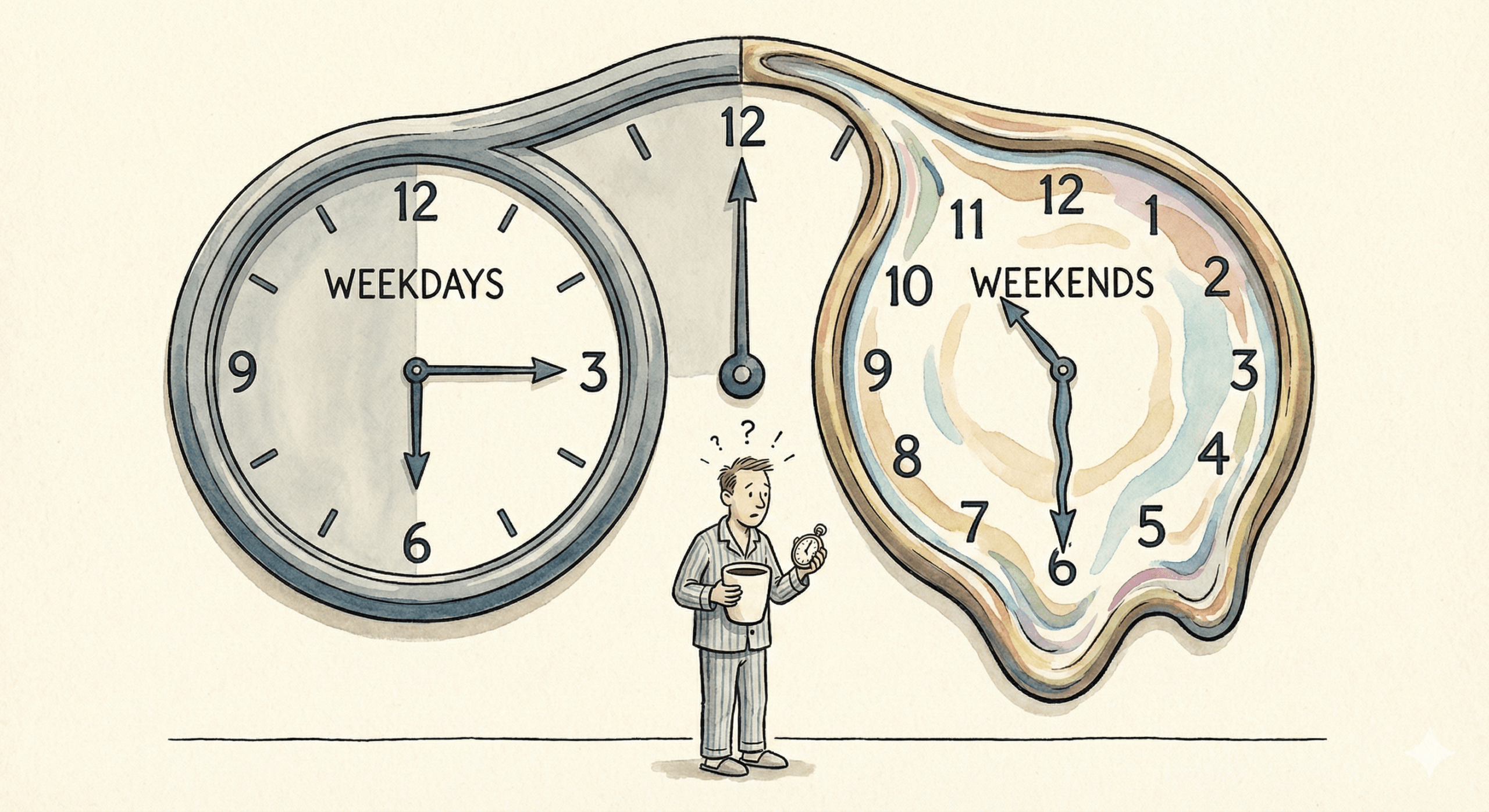
- Circadian Alignment: Stability prevents “social jetlag,” allowing metabolic and hormonal systems to function without the stress of constant readjustment.
Takeaway 1: Why Stability Is the Gold Standard
The study first identified a group with a “normal stable” sleep pattern. These individuals consistently slept between 7.4 and 7.5 hours per night over the course of the study. This group had the lowest risk of cardiovascular events and all-cause mortality, establishing them as the healthy baseline for comparison.
The critical insight here is the value of a routine. Predictability allows our internal systems to function optimally, offering a powerful protective effect. But what happens when this stability is lost?
Takeaway 2: A Downward Trend Is a Serious Warning Sign
Researchers identified a “normal decreasing” sleep pattern, where participants’ average sleep duration dropped from 7.0 hours to just 5.5 hours over a four-year period. This downward trend was associated with a 34% higher risk of death from any cause compared to the stable sleepers.
This implies that the process of becoming a short-sleeper over time is a distinct health risk, separate from simply having a fixed sleep duration.
Takeaway 3: The Counter-Intuitive Risk of “Catching Up”
Perhaps the most surprising finding came from the “low increasing” group. These individuals started as short sleepers (4.9 hours) but increased their sleep to 6.9 hours over four years. Despite this improvement, this group was still associated with a 22% higher risk of cardiovascular events.
This suggests that the physiological damage caused by a period of chronic short sleep is not easily reversed, or that the instability of a fluctuating sleep pattern is, in itself, a stressor.
Takeaway 4: Risks of Chronic Short Sleep (Less Than 5 Hours)
The study identified a “low stable” group—individuals who consistently slept less than 5 hours per night. This pattern was linked to the highest risks identified in the entire study.
Compared to normal stable sleepers, chronic short sleepers faced:
- A 47% higher risk of cardiovascular events (heart attack, stroke).
- A 50% higher risk of all-cause mortality.
The researchers were unambiguous in their conclusion: “People reporting consistently sleeping less than 5 hours per night should be regarded as a population at higher risk.”
Action Plan: How to Stabilize Your Schedule
The data might seem daunting, but the solution is straightforward. You don’t need to be perfect; you just need to be more consistent. Here is a 3-step protocol to reset your circadian rhythm:
1. Anchor Your Wake-Up Time
The most important signal for your biological clock is light exposure upon waking. Pick a wake-up time you can maintain every day (including weekends) within a 30-minute window. This “anchor” stabilizes your hormone release for the rest of the day.
2. The “Buffer Zone” Rule
You cannot switch from “high-stress work” to “deep sleep” instantly. Create a 45-minute buffer zone before bed where screens are off and lights are dimmed. This signals to your brain that the sleep window is approaching, making it easier to fall asleep at the same time nightly.
3. Stop Chasing the “Lost” Hours
If you have a bad night of sleep, do not try to compensate by sleeping in or napping excessively the next day. This creates the “yo-yo” effect seen in the study’s high-risk groups. Accept the fatigue, stay awake until your normal bedtime, and protect your long-term stability.
Conclusion: Your Sleep Trajectory Matters
The core message is clear: it’s time to stop thinking of sleep as a daily debt to be paid and start seeing it as a long-term investment. The consistent sleep schedule benefits proven by this study suggest that the regularity of your deposits, year after year, yields the greatest return.
Instead of asking, “How much did I sleep last night?”, perhaps the more important question is, “What direction has my sleep been trending in for the past few years?”
References
- Wang, C., Bangdiwala, S. I., Rangarajan, S., et al. (2019). Association of estimated sleep duration and naps with mortality and cardiovascular events. European Heart Journal.
- Kailuan Medical Group Longitudinal Analysis (2006-2017).
Medical Disclaimer: The content on this website is for informational purposes only and does not constitute medical advice. The statistics regarding mortality and cardiovascular risk are based on population-level data and may not apply to every individual. Always consult your doctor regarding sleep disturbances or health concerns.