


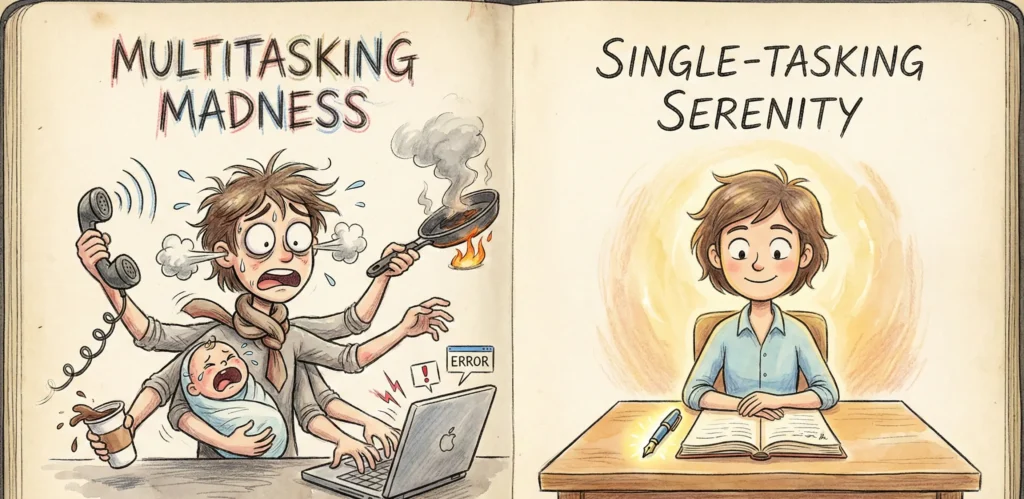
TL;DR – The Focus Cheat Sheet
- The Myth: “Multitasking” makes you productive. In reality, it drops your IQ by up to 15 points.
- The Cost: Every time you switch tasks, you pay a “Cognitive Tax” that drains your energy.
- The Trap: Unwieldy to-do lists cause “Analysis Paralysis,” leading to procrastination.
- The Fix: The “Magic Number 7.” Limit your daily list to 7 conquerable items to force prioritization.
In the battle of Multitasking vs. Single-Tasking, we often deceive ourselves. We wear “busy” like a badge of honor, believing that juggling three projects at once proves our ambition.
But focus is not an infinite well; it is a finite, precious resource. When you attempt to split your attention across competing demands, your efficacy dissipates. Visualize your brain as a pipe: instead of a powerful, singular stream of water, multitasking punches holes in the pipe until you are left with nothing but a weak drip.
Research from the American Psychological Association reveals the harsh truth: heavy multitaskers are actually worse at organizing their thoughts and filtering irrelevant information.
Here is the difference between the two operating systems.
The Cheat Sheet: Multitasking vs. Single-Tasking
| Feature | The Multitasker’s Trap | The Single-Tasker’s Resolve |
|---|---|---|
| Attention Style | Fractured (Leaking Energy) | Channeled (Laser Focus) |
| Work Quality | Diminished (Error-Prone) | High-Caliber (Deep Work) |
| Execution | “Half-Finishing” Cycle | End-to-End Completion |
| Outcome | Busy but Stalled | Productive and Done |
1. The “Switch Cost”: The Hidden Price of Multitasking
The biggest lie of multitasking is that we can instantly switch between tasks with zero penalty. In reality, the brain pays a heavy “Switch Cost.”
Every time you jump from a report to an email and back again, a portion of your attention remains stuck on the previous task. This concept, researched by Professor Sophie Leroy, is called Attention Residue.

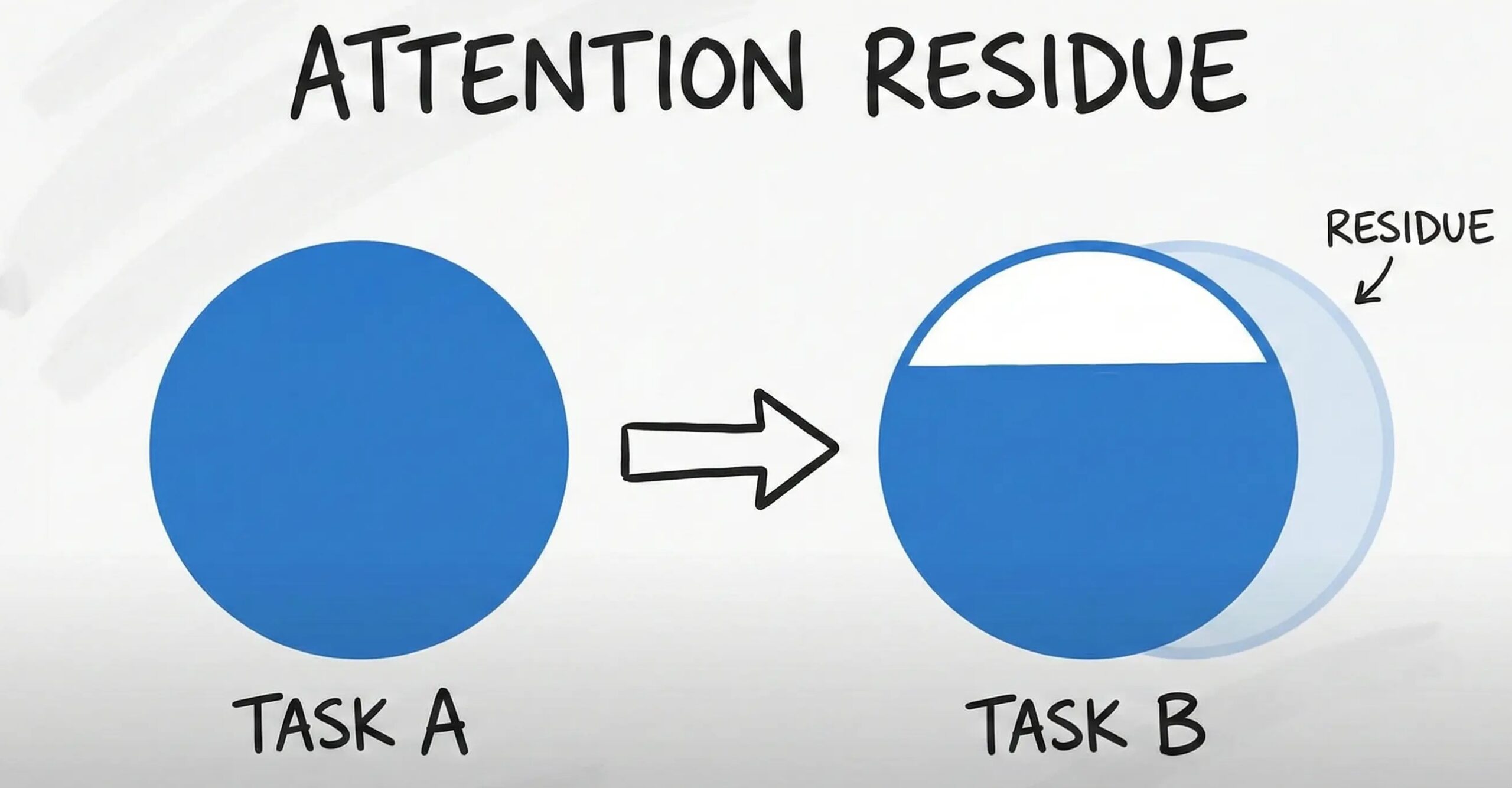
By the end of the day, a multitasker hasn’t actually done more work; they have simply wasted more energy transitioning between work. This leads to the same exhaustion discussed in our Hustle vs. Curiosity guide—you are tired not from achievement, but from friction.
2. The Procrastination Trap: Why Multitasking Kills Focus
Paradoxically, the desire to do everything at once often leads to doing nothing at all.
When you stare at an unwieldy to-do list with 25 items, your brain views the workload as a threat. This triggers “Analysis Paralysis.” Instead of picking one thing, you freeze. This is why multitasking is often just procrastination in disguise—it’s a way to feel busy without facing the discomfort of deep, singular focus.
The Cheat Code: A long list isn’t a roadmap; it’s a psychological weight. If your list is too long to finish, your brain won’t even start.
3. The Single-Tasking Solution: The “Magic Number Seven”
To escape the multitasking trap, you must implement a structural antidote: Artificial Restriction.
Psychologist George Miller famously argued that the human brain can only hold about seven objects in working memory at once. We can apply this law to your productivity.
The Strategy:
- Limit the List: Restrict your daily agenda to exactly seven (or fewer) items. This constraint is non-negotiable.
- Ruthless Evaluation: A seven-slot limit forces a strategic audit. You can no longer hide “busywork” on your list because there isn’t room for it.
- Ensure They Are “Conquerable”: Every item must be something that can be finished from start to end today.
This facilitates the shift from a multitasker who starts things to a single-tasker who finishes them. It aligns perfectly with the strategy of building a Resilient Dream—you are building momentum through small, completed victories rather than drowning in open loops.
The Verdict
The modern professional faces a constant battle. One path results in a cycle of perpetual motion without progress. The other prioritizes the only metric that matters: completion.
Reject the habit of “half-finishing.” Adopt the single-tasker identity. Limit your list to seven, close your tabs, and reclaim your focus.
Frequently Asked Questions
Is multitasking ever good?
Generally, no. While you can technically do two things at once (like walking and talking), you cannot perform two cognitive tasks simultaneously. Your brain is simply rapid-switching, which lowers IQ and increases error rates.
What is the “Switch Cost” effect?
Switch Cost is the mental energy lost when you transition between tasks. It can take up to 23 minutes to fully regain focus after a distraction, meaning constant multitasking can effectively lose you 40% of your productive day.
How do I start single-tasking?
Start by using the “Magic Number 7” rule to limit your daily tasks. Then, use time-blocking techniques (like Pomodoro) to dedicate set windows to one specific task, turning off all other notifications during that block.