


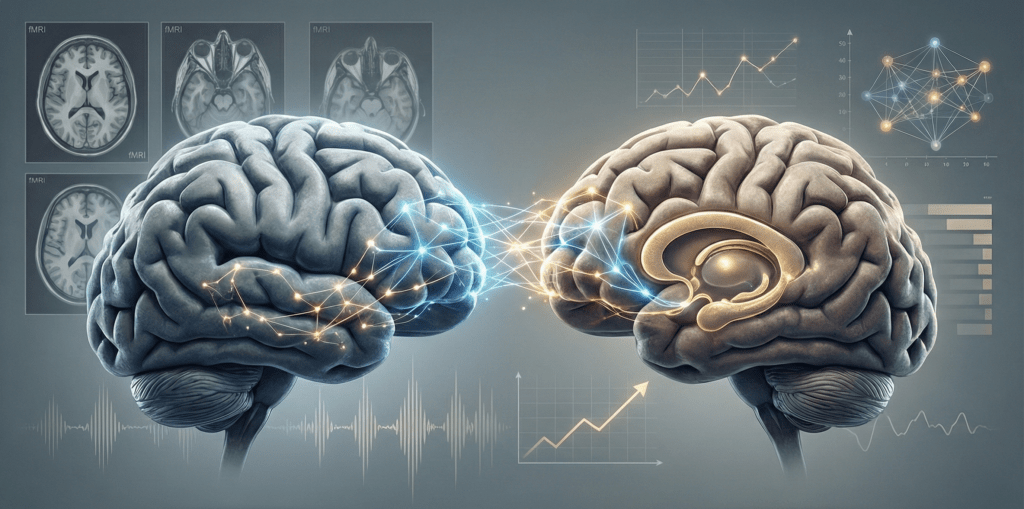
Have you ever found yourself walking in perfect step with a friend without trying? Or noticing that you and a colleague unconsciously mirror each other’s posture during a deep conversation? We often dismiss these moments as coincidences or mere “rapport.” But neuroscience suggests something far more profound is happening beneath the surface. This phenomenon is known as social synchrony—when our behaviors and body rhythms naturally align with the people around us. It’s the human equivalent of birds flocking or fish schooling. While it looks like simple imitation on the outside, on the inside, it triggers a powerful biological cascade that fundamentally changes how we perceive reality and connect with one another.
This article explores five counter-intuitive scientific findings that will change how you think about human connection. By understanding what the research reveals, you can more effectively cultivate deeper relationships and harness the neurochemical power of synchrony in your daily life.
How Synchrony Triggers Oxytocin Release in Your Brain
We often think of imitation as the sincerest form of flattery, but biologically, it acts more like a drug. Research comparing synchronous interactions (where one person mirrors another’s hand gestures) against non-synchronized ones found that moving in sync triggers the release of oxytocin—the “bonding hormone.”
As demonstrated in a 2017 study by Spengler and colleagues, this release happens in both the person doing the imitating and the person being imitated. The researchers even suggested that being imitated by others may work similarly to receiving an artificial dose of oxytocin. This means that when we get “in sync” with someone, we aren’t just communicating—we’re mutually medicating one another with a neurochemical that promotes trust and bonding.
But oxytocin doesn’t just make us feel warm and fuzzy. It fundamentally changes how we process the world around us.
How Social Synchrony Improves Emotional Recognition and Reading
One of the most surprising findings is that synchrony doesn’t just make us feel closer—it actually sharpens our senses. The oxytocin released during synchronized moments helps us filter out distractions and tune into what really matters in social interactions.
According to research reviewed by Fineberg and Ross (2017), oxytocin improves the “signal-to-noise ratio” of social processing. It modulates the balance in sensory circuits to make social signals more distinct against background noise.
When oxytocin levels are elevated, ambiguity decreases. We become better at recognizing facial expressions and vocal cues—specifically those related to happiness and fear. The Spengler study found that synchronized interactions enhanced participants’ ability to decode these crucial emotional signals. It essentially turns up the volume on the social signals that matter most, allowing us to read the room and the person in front of us with greater clarity.
By quieting the background noise of our environment, synchrony allows us to tune into the specific frequency of our partner. This enhanced perception creates a foundation for the next remarkable discovery.
The Self-Reinforcing Cycle: How Oxytocin Creates Better Communication
Social synchrony isn’t a static state—it’s a self-perpetuating engine. The research reveals a circular process: synchrony triggers oxytocin release, which enhances our emotional expressiveness, which in turn makes it easier to stay synchronized.
When we’re in sync, we don’t just receive signals better—we broadcast them better too. The Spengler research team discovered that higher oxytocin levels make our own facial expressions and vocal tones for happiness and fear more intense and easier for others to read. This creates a “dynamic, living tissue” of connection where we affect each other’s biology in real-time.
This biological amplification helps explain why some conversations feel effortless while others feel like work. But the benefits of this neurochemical state extend beyond just communication clarity.
How Oxytocin Reduces Judgment and Strengthens Relationship Bonds
The biological cascade triggered by synchrony and connection does more than sharpen our senses—it also softens our judgments. Higher levels of oxytocin act like “rose-colored glasses,” reducing our sense of threat and making us less critical of our partners.
In a study examining gratitude interactions by Algoe and colleagues (2017), participants with higher oxytocin levels perceived their partners as responsive and supportive regardless of how the partner actually behaved during the conversation. This wasn’t about delusion—it was about the biological state creating a protective buffer around the relationship.
This finding suggests that the biological state achieved through synchrony creates a safety net. It safeguards the bond by ensuring that even imperfect interactions are interpreted through a lens of safety and acceptance. In practical terms, this means that when we’re truly in sync with someone, we’re more forgiving of their minor missteps and more likely to give them the benefit of the doubt.
While these neurochemical effects might seem like modern discoveries, they’re actually tapping into something ancient.
The Evolutionary Origins of Social Synchrony: Ancient Survival Mechanisms
While we experience synchrony today through dance classes, choir singing, or effective teamwork, its roots run deep in our evolutionary past. In nature, synchrony is a survival mechanism seen in the swarming of insects and the herding of mammals.
As explored in research by Bosch and Young (2018) on oxytocin and social relationships, in humans, this “ancient tech” has been repurposed to support complex social abilities like cooperation and trust. The oxytocin system that once helped our ancestors identify safe group members and coordinate collective action now helps us build marriages, friendships, and professional partnerships.
When a team “clicks,” or a marching band moves as one, they’re tapping into a biological drive that once helped our ancestors survive. The exhilaration we feel watching good teamwork—whether in sports or the arts—is our response to this ancient impulse for unity. We’re wired to find safety and pleasure in moving together, and that wiring still influences our modern social lives in powerful ways.
Conclusion: What Social Synchrony Means for Your Brain and Relationships
Social synchrony is far more than a happy accident of conversation. It’s a biological key that unlocks our brain’s capacity for deep connection. By synchronizing our behaviors, we trigger a neurochemical loop that enhances our ability to send and receive emotional information, softens our judgment of others, and binds us together in a shared reality.
The science is clear: the quality of our connections matters more than we might have realized. When we walk in step with a friend, mirror a colleague’s posture, or find ourselves in perfect rhythm during a conversation, we’re not just being polite or friendly—we’re activating an ancient biological system designed to create and maintain the bonds that kept our ancestors alive.
Understanding this mechanism gives us practical power. We can intentionally cultivate synchrony through activities that promote shared rhythm—dancing, singing, collaborative work, even just taking walks together. We can recognize when we’re out of sync and take steps to re-establish connection. And we can appreciate that the simple act of being present with another person, moving and breathing and existing in the same space, is doing profound neurochemical work beneath the surface.
Research Sources
- Spengler, F. B., Scheele, D., Marsh, N., Kofferath, C., Flach, A., Schwarz, S., … & Hurlemann, R. (2017). Oxytocin facilitates reciprocity in social communication. Social Cognitive and Affective Neuroscience, 12(8), 1325–1333. https://academic.oup.com/scan/article/12/8/1325/3798613
- Fineberg, S. K., & Ross, D. A. (2017). Oxytocin and the Social Brain. Biological Psychiatry, 81(3), e19–e21. https://www.biologicalpsychiatryjournal.com/article/S0006-3223(16)32945-8/fulltext
- Algoe, S. B., Kurtz, L. E., & Grewen, K. (2017). Oxytocin and Social Bonds: The Role of Oxytocin in Perceptions of Romantic Partners’ Bonding Behavior. Psychological Science, 28(12), 1763–1772. https://journals.sagepub.com/doi/10.1177/0956797617716922
- Bosch, O. J., & Young, L. J. (2018). Oxytocin and Social Relationships: From Attachment to Bond Disruption. Current Topics in Behavioral Neurosciences, 35, 97–117. https://link.springer.com/chapter/10.1007/7854_2017_10
About DailyCheatSheet: We distill complex research into actionable insights. Our team spends 10+ hours researching each topic to bring you science-backed self-improvement content. Have feedback? Contact us.